

Automated Debt Collection Letters: A Scalable, Compliant Mailing Workflow
What if you could automate the physical work behind collection letters without handing account decisions to software? Automated debt collection letters can move from approved documents to mailed pieces through a repeatable workflow, while your team remains responsible for account judgment, letter content, and compliance decisions.
Manual preparation takes time. Printing, folding, stuffing envelopes, and handling postage can also make consistent follow-up harder as volume grows. Errors in documents or recipient data can create operational and compliance concerns. These are good reasons to streamline production, not to remove human oversight.
This article explains how to build a scalable letter production and mailing workflow, from preparing accurate files to reconciling mailing records. It covers how submission through a portal, email, or RESTful API can reduce repetitive in-house steps, with printing, folding, envelopes, and USPS postage handled as part of the mailing process. You’ll also learn where to set review checkpoints and keep compliance decisions in human hands, so efficiency doesn’t come at the expense of care or control.
Key Takeaways
- Automated debt collection letters can streamline recurring document preparation and physical mailing, but they don’t replace collection strategy or account-level judgment.
- Use a defined sequence of data checks, content approval, production, mailing, and record reconciliation to keep batches organized.
- Compare manual mailing, collections software, email, and print-and-mail workflows by the tasks each handles and the oversight they require.
- Use a preflight checklist to review data quality, authorization, security, and post-submission records before scaling letter batches.
- Postal Methods handles printing and mailing after document submission through a portal, email, or RESTful API.
What Automated Debt Collection Letters Can, and Cannot, Do
Automated debt collection letters are recurring collection documents prepared and sent through a digital workflow that moves approved content and account details into physical mail. Automation can standardize production and reduce repetitive handling. It doesn’t decide which accounts to pursue, guarantee payment, or establish that a letter or collection practice complies with applicable requirements.
Keep the functions distinct. Letter generation puts approved language and account information into a document. Collection strategy determines what action to take and when. Payment processing handles transactions. Physical-mail fulfillment prints, folds, prepares envelopes, and mails the document. These steps may connect within an organization’s workflow, but they aren’t interchangeable. For a broader overview of the debt collection process, see the background on debt collection and its practices.
Which parts of a collection letter workflow can be automated?
A digital workflow can apply approved templates, populate account details, and accept batches for production. A mailing service can then print and fold the documents, prepare envelopes, apply postage, and mail them. This moves repetitive physical handling out of the office.
Your organization still decides which accounts are eligible, verifies the data, and approves letter content before submission. This production workflow is separate from automated reminders, payment portals, or collection agency activity. It prepares and mails correspondence; it doesn’t make account decisions or manage collections strategy.
Why do businesses use physical letters alongside digital outreach?
A mailed letter can provide a tangible communication channel when a recipient, an internal policy, or applicable requirements make physical correspondence appropriate. It can also suit workflows that require recurring notices in a consistent format. That doesn’t mean every account or recipient requires a mailed letter.
Choose the channel based on account context and applicable requirements. Digital messages may serve different purposes, while physical mail provides a printed document sent through the postal system. Neither channel alone guarantees receipt, compliance, or recovery. Keep channel decisions and content review under human oversight, and automate the repeatable production steps.
How the Automated Debt Collection Letter Process Moves from File to Mailbox
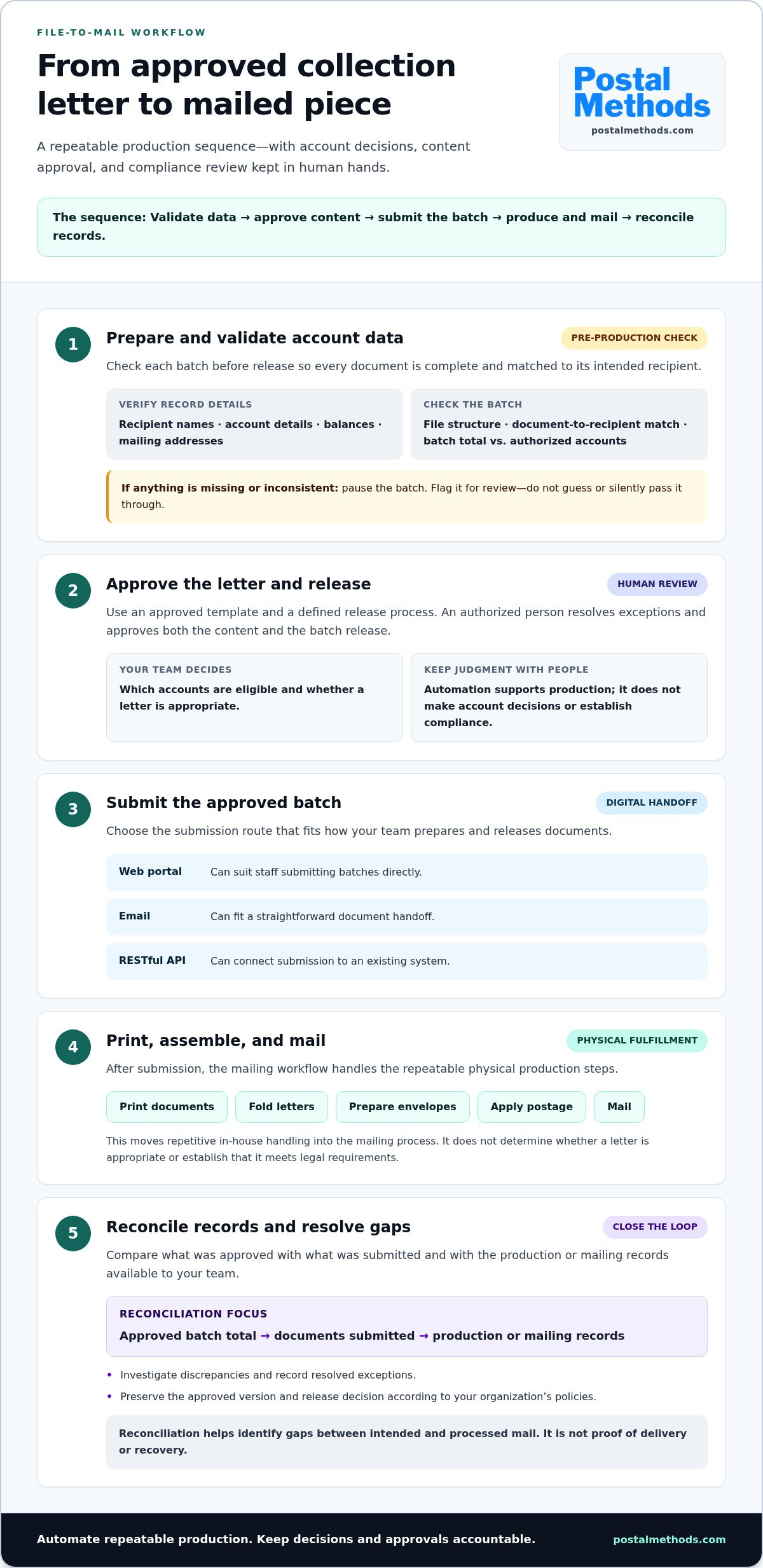
A reliable workflow does more than send files to a printer. It establishes a clear handoff, with checks before production and reconciliation afterward. Prepare and validate account data, approve letter content, submit the batch, print and assemble each letter, mail it, then reconcile production and mailing records.
What should happen before a letter batch is submitted?
Start with an approved template and a defined release process. Check recipient names, account details, balances, and mailing addresses against your organization’s records. Confirm the file structure and verify that each document is matched to the intended recipient. Compare the batch total with the number of accounts authorized for mailing.
Pause the batch when information is missing or inconsistent. A blank address, an incomplete document, or a mismatch between a letter and its account should be flagged for review, not guessed at or silently passed through. Assign an authorized person to resolve exceptions and approve both the content and the release. Organizations subject to the Fair Debt Collection Practices Act (FDCPA) can consult the FTC’s primary text with qualified counsel when reviewing applicable requirements.
What happens after digital submission?
Once approved, files can move to production through a web portal, email, or a RESTful API. A portal can suit staff submitting batches directly; email can fit a straightforward document handoff; an API can connect submission to an existing system. Choose the route that fits how your team prepares and releases documents.
After submission, fulfillment has distinct physical steps: documents are printed, folded, placed in envelopes, prepared with postage, and mailed. These steps replace repetitive in-house handling, but they don’t determine whether a letter is appropriate or establish that it meets legal requirements.
Close the loop by comparing the approved batch total with the documents submitted and the production or mailing records available to your team. Investigate discrepancies, record resolved exceptions, and preserve the approved version and release decision according to your organization’s policies. Reconciliation helps identify gaps between what you intended to send and what entered the mailing workflow. It isn’t proof of delivery or recovery.
To move physical production out of the office, Postal Methods’ digital-to-mail services handle document printing, folding, envelopes, postage, and mailing after submission.
Automated Letters vs. Manual Mailing, Collection Software, and Email
These options solve different problems. Manual mailing leaves each production step to staff. Collections software may organize account activity. Email sends a digital message. Automated print-and-mail handles physical document production. Automated debt collection letters fit best when you need a repeatable way to turn approved documents into mailed correspondence, not when you need software to decide collection strategy.
- In-house manual mailing: Staff print, fold, prepare envelopes, and handle postage. It offers direct oversight, but recurring batches require hands-on time.
- Collections software: Depending on the platform, it may manage account queues, contact cadence, and prioritization. It can support oversight of collection activity, but that doesn’t necessarily include producing physical mail.
- Email: It delivers digital communication without printing or postage. Teams still need to manage message content, recipient details, and channel decisions.
- Automated print-and-mail: Submitted documents are produced and mailed as physical correspondence. Staff remain responsible for account decisions, content approval, and exception review.
These approaches can work together. A collections platform might organize follow-up, while an approved letter goes through a print-and-mail workflow. Email may also be used where appropriate. Keep channel choices aligned with account context and applicable requirements, and consult the CFPB’s guidance on consumer rights in debt collection when reviewing consumer-facing communications.
When does automated print-and-mail make more sense than manual processing?
Consider it when staff repeatedly assemble similar letters and physical production competes with other work. A consistent batch process can reduce manual printing, folding, envelope preparation, and postage handling. Occasional correspondence or letters that need substantial individual customization may be better suited to a hands-on workflow.
How does mailing automation differ from collections management software?
Collections software can help manage activity across accounts; print-and-mail fulfills documents after they’re prepared and approved. Set clear handoffs: who selects accounts, who approves content, who releases a batch, and who reviews exceptions. Approval gates and exception holds keep people involved where judgment matters, while still allowing routine production to be automated.
For physical production, Postal Methods’ digital document mailing services move submitted correspondence through printing, envelope preparation, postage, and mailing.
A Practical Checklist for Scaling Debt Collection Letter Batches
Scaling a mailing workflow takes more than preparing a larger file. Use a repeatable preflight to catch problems before release, assign clear ownership, and review what happened after submission. Adapt the checklist to your organization’s policies and controls.
What should a debt letter batch checklist include?
- Readiness: Confirm the current approved template and the correct submission procedure.
- Data quality: Validate recipient records, account details, addresses, document-to-recipient matching, and batch totals. Hold records with missing or inconsistent information for review.
- Authorization: Confirm the accounts are approved for the planned communication. Assign an owner to approve the content and release the batch.
- Security: Limit file access to authorized staff and follow your organization’s approved procedures for handling and submitting files. Avoid adding sensitive information to unapproved channels.
- Post-submission review: Reconcile the submitted batch against available production or mailing records, and log exceptions for follow-up.
Don’t rely on assumptions in a template for legal content, timing, or consumer-protection requirements. Have qualified counsel review applicable federal and state requirements and your organization’s policies. Mailing a document doesn’t establish that its content or timing meets those requirements. If a particular mailing method, such as certified mail, is being considered, assess its purpose and suitability carefully. The method alone doesn’t guarantee delivery or prove compliance.
How can teams monitor quality without slowing every batch?
Use controls suited to your process. A sample review can help catch formatting or matching issues, while an exception queue keeps incomplete addresses or files from moving forward unnoticed. Record approvals and submissions using your established procedures. After each run, review recurring errors and fix their source, such as an inconsistent data field, before the next batch.
This lets automated debt collection letters move through routine production without removing human oversight. People retain control of release decisions, and repeatable checks help identify exceptions early.
Ready to reduce in-house printing and assembly? Explore digital document mailing through Postal Methods.
How Postal Methods Supports Automated Debt Collection Letter Mailing
Postal Methods handles the production-and-mailing layer for approved correspondence. Submit digital documents, then move them through printing, folding, envelope preparation, USPS postage, and mailing. This takes repetitive physical steps off your team’s plate while leaving collection strategy and account decisions where they belong: with your organization.
Which submission route fits your existing process?
Choose a route that suits how your team prepares and releases documents. The web portal provides a direct way to submit documents for mailing. Email-to-mail supports an email-based handoff. RESTful API integration can connect document submission with an existing operational workflow. Each is a submission path, not a substitute for checking documents before release.
If you’re evaluating how to move production outside your office, Postal Methods’ digital document mailing services provide a way to move from digital files to physical mail.
What does Postal Methods handle in the mailing workflow?
After submission, Postal Methods handles document printing, folding, envelopes, USPS postage, and mailing. Those steps replace the in-house routine of printing letters, folding pages, stuffing envelopes, and preparing postage. Postal Methods offers per-piece transactional mailing and quoted custom or bulk project arrangements. Per-piece fees include paper, envelopes, printing, folding, and USPS postage; custom project pricing varies with volume, paper stock, and assembly needs.
The service fulfills physical correspondence. Your organization remains responsible for accurate recipient and account data, approving letter language, deciding which accounts receive communication, and reviewing applicable policies and requirements. Mailing a letter doesn’t by itself establish compliance, confirm delivery, or ensure recovery.
To assess the operational fit, gather the document type, expected mailing pattern or project scope, preferred submission route, and internal steps for approving a batch. Then explore Postal Methods mailing services to see how submitted documents move from digital files to physical mail.
Make Your Letter Workflow Easier to Scale
Automated debt collection letters can bring consistency to recurring document production and mailing, but automation works best when people still review account data, approve content, and make collection decisions. A clear preflight process, exception review, and record reconciliation help keep batches organized without confusing mailing fulfillment with collections management or legal compliance.
Postal Methods handles the physical mailing steps after you submit approved documents. Choose a web portal, email, or RESTful API to fit your workflow. Printing, folding, envelopes, and USPS postage are handled as part of the mailing process. Per-piece transactional mailing and quoted custom or bulk project arrangements are available.
Ready to move repetitive production out of your office? Explore Postal Methods print and mail services and find a practical next step for your letter workflow. A more manageable process can start with one well-prepared batch.
Frequently Asked Questions
What are automated debt collection letters?
Automated debt collection letters are collection documents prepared and sent through a digital workflow. Approved templates can be populated with account details, then submitted for printing and mailing in batches. Automation can make recurring production more repeatable and reduce manual assembly. It doesn’t decide which accounts to pursue, approve letter content, process payments, guarantee recovery, or determine whether a collection practice meets applicable requirements.
Can debt collection letters be automated without losing human review?
Yes. Automate repetitive steps while keeping people responsible for judgment and approval. Staff can check account eligibility, validate names, balances, and addresses, approve letter language, and authorize batch release. Set aside incomplete records or mismatches for review instead of sending them through automatically. This reduces routine handling while preserving human oversight of account decisions, exceptions, and the content sent to recipients.
How does automated debt collection letter mailing work?
The organization prepares account data and approved documents, checks recipient details and batch totals, then submits the files through a suitable workflow. A print-and-mail service produces the documents, folds them, prepares envelopes, applies postage, and mails them. The organization can then reconcile available production or mailing records against the approved batch. This process handles physical fulfillment, not account decisions or proof of delivery.
Are automated debt collection letters compliant with the FDCPA?
Automation alone doesn’t make a letter or mailing process compliant with the Fair Debt Collection Practices Act (FDCPA). Applicability and requirements depend on the circumstances, and state rules may also matter. Have qualified counsel review the letter language, timing, account workflow, and relevant consumer protections. Keep human approval in the process, and don’t treat successful file submission or mailing as confirmation of compliance.
Is email enough, or should a business mail collection letters?
Neither email nor physical mail is automatically the right channel for every account. Choose based on the recipient, account context, internal policy, and applicable requirements. Email supports digital communication; mailed correspondence provides a physical document and may suit a workflow that calls for printed notices. Review channel decisions and approved content before sending. A mailing method by itself doesn’t guarantee receipt, compliance, or payment.
What should a business check before sending a bulk collection letter batch?
Confirm the current approved template, recipient records, account details, balances, and mailing addresses. Check that each document matches the intended recipient and that batch totals align with the number of authorized accounts. Review file completeness, access permissions, and approved submission procedures. Assign an owner to approve release and resolve exceptions. Have qualified counsel review legal content and timing where needed, then reconcile available records after submission.
Can a print-and-mail service manage debt collection decisions?
No. A print-and-mail service handles physical document production and mailing, not collection strategy or account-level decisions. Postal Methods accepts documents through a web portal, email, or RESTful API, then handles printing, folding, envelopes, USPS postage, and mailing. Your organization remains responsible for accurate data, approved letter content, account selection, and release decisions. Keep those responsibilities clear at every handoff.