
Easiest Way to Send 500 Letters and Compare Postage Rates
Five hundred letters is enough to meet the minimum for a Presorted First Class Mail mailing. The easiest way to send 500 letters is to prepare them as one qualifying bulk mailing rather than handle each envelope separately. Bulk postage can differ from the cost of mailing individual stamped letters, and postcard rates follow different pricing rules.
Sending a few hundred pieces takes more than addressing envelopes. Format, weight, and preparation all affect how the mailing is handled. This guide explains the minimum quantity, how postcard and letter postage compare for a 500-piece mailing, and what affects eligibility for presorted rates. You’ll get a clear view of the choices before deciding how to move your mailing from files to recipients.
Key Takeaways
- A Presorted First Class Mail mailing has a 500-piece minimum, but meeting the quantity alone doesn’t determine eligibility.
- Letter and postcard postage can differ. Format, weight, and mailing preparation affect which rate applies.
- A large drop-off involves practical handling considerations, so understand the process before bringing a batch to a post office.
- Before using a mailing service, consider how it handles your files, print preparation, postage, and the completed mailing.
- Postal Methods can print and mail business documents, including invoices, legal documents, and notices, so you can hand off repetitive mailing work.
Minimum bulk mailing quantity
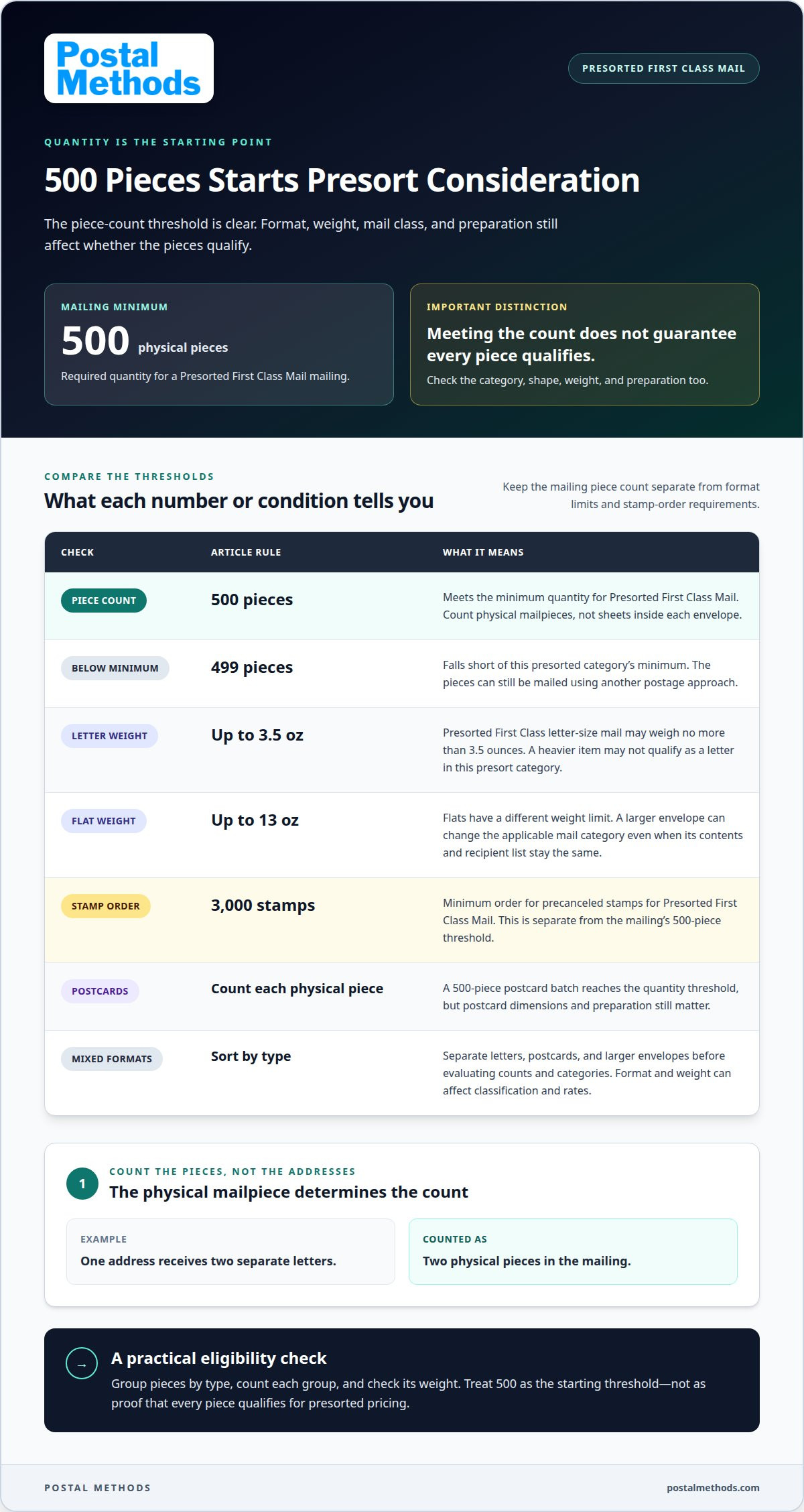
For Presorted First Class Mail, the minimum mailing quantity is 500 pieces. A batch of 500 letters reaches that threshold, while a batch of 499 does not. The number refers to pieces in the mailing, not the number of sheets inside each envelope. Reaching the minimum is the first condition, not proof that every piece qualifies for presorted pricing. Mail class, shape, weight, and preparation also affect eligibility.
That distinction matters if the goal is the easiest way to send 500 letters. Count the mailpieces you plan to send, then consider whether they fit the letter-size category. A list with 500 addresses does not necessarily equal 500 prepared, mailable pieces. For example, one address may receive two separate letters, creating two pieces. The physical items being mailed determine the count.
Weight is one practical limit. Presorted First Class letter-size mail may weigh no more than 3.5 ounces. A letter that exceeds that limit may not qualify as a letter under this presort category. Flats have a different weight limit: up to 13 ounces. A larger envelope can therefore change the applicable mail category, even when the contents and recipient list stay the same.
Use these distinctions to interpret the 500-piece minimum:
- 500 eligible pieces: Meets the minimum quantity for a Presorted First Class Mail mailing.
- Fewer than 500 pieces: Falls short of this category’s minimum, though the items can still be mailed using another postage approach.
- 500 pieces with oversized or heavier items: Meets the count, but format and weight still affect classification and rates.
For instance, 500 standard letter-size envelopes weighing within the 3.5-ounce limit meet the quantity and stated weight conditions for letter-size presort. That example does not establish eligibility by quantity alone. The pieces must also meet the requirements that apply to their mail class and preparation. A batch of 500 heavier envelopes cannot be treated as qualifying letter-size mail simply because the total is high enough.
Postcard mailings follow the same basic counting logic: count physical mailpieces, then assess the format. A 500-piece postcard batch reaches the quantity threshold, but postcard dimensions and preparation still matter. Mixing postcards, letters, and larger envelopes can complicate the count and category. Separate the formats before evaluating the mailing, so the total for each intended category is clear.
Quantity also shapes the choice between presort and individual postage. If you have fewer than 500 pieces, the presorted minimum is not met; individual postage remains a separate way to mail them. If you have exactly 500, the quantity condition is met, but the mailing still needs to fit the relevant category. If you have more than 500, the extra pieces do not remove format or weight requirements.
Before assembling the batch, group pieces by type and check each group’s count and weight. Keep letter-size items separate from flats, and avoid assuming that one envelope size suits every document. This simple sorting step makes the 500-piece threshold easier to evaluate. It also clarifies whether the mailing is being counted as one consistent group or several distinct formats.
The key rule is specific: Presorted First Class Mail requires at least 500 pieces. Treat that as the starting point, then assess the shape, weight, and category of each piece. A qualifying count opens the door to presort consideration; it does not make every 500-piece mailing interchangeable.
Another quantity to keep separate from the piece count is the amount of postage purchased. Precanceled stamps for Presorted First Class Mail have a minimum order of 3,000 stamps. This is an order minimum for stamps, not a change to the mailing’s 500-piece threshold. A mailing can meet the piece-count requirement while the stamp order still has its own minimum, so the two quantities should not be treated as interchangeable.
When considering postage, keep these checks distinct: establish how many eligible physical pieces are in the mailing, then consider whether the stamp order meets its stated minimum. The mailing count is not a substitute for the required stamp quantity. The 3,000-stamp minimum applies to an order of precanceled stamps, while the 500-piece figure remains the mailing threshold described above. Keeping the two amounts separate helps clarify whether the question is how many pieces are being mailed or how many stamps are being ordered. Meeting one threshold does not, by itself, establish that the other has been met.
Can a post office accept 500 letters in one drop-off, and should I call ahead?
For a batch of 500 letters, contact the specific post office before planning a single drop-off. Ask how that location wants a large mailing presented and whether it can process your batch through the service you intend to use. This avoids treating a bulk mailing like a handful of individually stamped envelopes. The location’s instructions should shape your drop-off plan.
Calling ahead is especially useful when you expect presorted handling. A 500-piece Presorted First Class Mail mailing has a minimum quantity, but meeting it does not answer how a particular location receives prepared mail. Ask whether the batch should be presented at a counter, handled through another process, or brought in a particular form. Avoid assuming every mailing follows the same intake procedure.
Have the key details ready before calling. Explain that you have 500 pieces, whether they are letters or postcards, and whether they are already addressed and prepared. If the mailing includes more than one format, describe the groups separately. For example, a batch with letters and postcards may need different handling instructions from a batch of identical envelopes.
- Quantity: State that the mailing contains 500 pieces, and say whether that count is final.
- Format: Identify letters, postcards, or a mix of mailpiece types.
- Preparation: Explain whether pieces are addressed, sealed, and ready for mailing.
- Drop-off: Ask where and how the location wants the prepared batch presented.
These details help clarify what “one drop-off” means for your mailing. Carrying 500 pieces into a post office is different from knowing how the location will accept and process them. A clear description gives staff a useful basis for explaining the next step. It also helps you avoid arriving with an unprepared batch when the location expects mail to be organized differently.
Keep the answers specific. If staff give instructions for a prepared mailing, note the required presentation and any documents they mention. If they distinguish between individual postage and presorted mail, make sure you understand which approach your batch follows. A mailing intended for presorted handling should not be assumed to qualify simply because it contains 500 pieces.
Calling ahead can help you plan how to transport the mailing. Five hundred envelopes can be awkward to carry loose, so use a sturdy container that keeps them together without damaging them. Keep different formats separate and follow any specific intake instructions you receive.
A phone call does not replace preparing the mailing correctly. It can answer handling questions, while the format and preparation determine what you are sending. A uniform batch of addressed letters, for example, is easier to describe than a mix of letters and postcards. Organize the pieces first, then explain the batch clearly.
For a smoother handoff, use this sequence: count the pieces, group them by format, and call the intended post office with those details. Confirm the drop-off process before transporting the batch. If preparing and mailing the pieces is the larger task, a digital-to-mail workflow can move documents from files to physical mail without making a post office visit the center of the process.
What are the risks of using a mailing service or bulk-mail vendor?
A mailing service can reduce the manual work behind 500 letters, but outsourcing shifts important tasks to another workflow. The main risks involve inaccurate recipient data, production mistakes, unclear postage handling, and limited visibility into progress. These are manageable concerns, not reasons to avoid every vendor. Identify who handles each step before sending files or approving a mailing.
Start with the address file. An outdated address, missing apartment number, or name in the wrong field can make mail undeliverable or misdirected. If customer records use separate name and address columns, map each field correctly to the document. An unclear file format can cause errors across the mailing, not just on one envelope.
Proofing is another important check. A wrong invoice date or notice amount can confuse the recipient, even if the envelope reaches the correct address. Confirm which document version is final and how you will communicate changes before production. If the mailing includes multiple versions, such as notices for different accounts, specify how each recipient should be matched to the correct document.
Use a short handoff checklist to reduce avoidable errors:
- File: Identify the approved recipient list and the document version for each group.
- Proof: Review a sample for layout, recipient fields, and the intended message.
- Postage: Clarify which mailing approach applies and what preparation it requires.
- Status: Establish how completion and any processing issue will be communicated.
Postage can also be misunderstood. A 500-piece mailing meets the minimum quantity for Presorted First Class Mail, but quantity alone does not establish that every piece qualifies. Format, weight, and preparation affect eligibility. A vendor’s estimate may depend on assumptions about letter size or the mailing method. If the finished pieces differ from those assumptions, the plan or expected postage treatment may change.
Pay attention to data handling when files contain personal, financial, legal, or medical details. Include only the information needed to produce and address the mailing. Clarify how files are submitted, who can access them during processing, and how completed files are handled. For example, keep account details on an invoice list out of unrelated production notes.
Timing and responsibility can become unclear when several people handle different steps. A business may provide a list, approve a proof, and expect the mailing to be processed, but undefined handoffs can cause delays. Set the sequence, approval point, and process for flagging file problems. Do not assume that “submitted” means “mailed”; they are different stages of production.
Look for clear answers on scope, file preparation, approvals, postage assumptions, and status updates. A provider’s explanation should make it possible to see what happens between uploading a file and completing the mailing. If the goal is to move documents into physical mail while reducing manual handling, explore a digital mailing workflow and consider whether it fits the documents and oversight your 500-letter project requires.
Before approving production, agree on when receipt will be confirmed, how problems will be reported, and when the mailing is considered complete. Keep a record of the approved proof and any later changes, and clarify how a delay or rejected file affects the planned mailing. An estimate is useful only when its assumptions are clear, so ask about the mailing method, preparation requirements, and applicable fees. Compare the estimate with the cost of handling postage yourself, using the same piece format and service.
Postage savings can depend on eligibility and setup, not just the vendor’s quoted rate. Using a permit imprint can provide a 4¢-per-piece discount on qualifying mailings of at least 200 First Class letter-size pieces, and the annual mailing fee for Presorted First Class Mail is $390 when applicable. For #10 business envelopes, Presorted First Class Mail can save 12%-24% compared with regular postage. Postage for a postcard sent by presorted mail can vary depending on its format and eligibility. Ask the vendor to identify which rates apply to your actual pieces and whether the estimate includes any applicable fee; do not treat a possible saving as guaranteed until format, weight, preparation, and postage handling are confirmed.
Postal Methods
Postal Methods helps businesses turn digital documents into printed, prepared, and mailed pieces. It is a practical option when assembling and sending a large batch by hand would add work for your team. Document production and mailing are handled together, so your team can focus on the recipient list and message instead of preparing every envelope individually.
Businesses can use Postal Methods for invoice, legal, notice, and sensitive medical document printing and mailing. The right service depends on the documents and mailing task. To get started, prepare the files and recipient data, then submit them through the portal, by email, or through the API.
Contact Postal Methods to discuss your mailing.
Make Your Next Mailing Easier to Manage
Use your next mailing to establish a repeatable process. Decide who prepares the recipient file, who approves the documents, and how the finished pieces move into the mail. Clear handoffs make future mailings easier to organize, especially when your team sends similar documents regularly.
The easiest way to send 500 letters is the approach that fits your documents and keeps preparation manageable. Postal Methods offers HIPAA Compliant Printing & Mailing Services, Invoice Printing and Mailing Services, and Legal Printing and Mailing Services. These options can help when your mailing includes sensitive medical correspondence, invoices, or legal documents that need to move from digital files to physical mail.
Bring your mailing needs into one conversation, including the document type and the workflow you want to simplify. Contact Postal Methods to discuss your mailing. A well-planned process can make the next batch feel more straightforward.
Frequently Asked Questions
What is the easiest way to mail 500 letters at once in the U.S.?
For business mail, use a print-and-mail workflow that prepares the documents and postage together. Postal Methods lets businesses submit letters through its portal, email, or API, then handles printing and mailing. The easiest way to send 500 letters is to organize the recipient data and document versions before submission. For sensitive medical communications, Postal Methods’ service is HIPAA-compliant, and its operations are SOC 1 and SOC 2 certified.
How can I print and apply postage to 500 letters efficiently?
Prepare a document file and recipient data, then submit them through a workflow suited to the mailing. Postal Methods supports portal options including upload, mail merge, and multiple documents, as well as email and API submission. Keep the recipient address in the proper location on each document. This lets the production process print, fold, stamp, and mail the letters without applying postage to each envelope by hand.