


The 2026 Guide to Outsourced Statement Processing: Efficiency and Compliance
Feeding paper into folding machines isn’t just tedious; it’s actively choking your cash flow. If your staff still spends hours printing, stuffing, and mailing paper invoices, you already know the frustration. Rising postage rates eat into margins, manual addressing errors delay payments, and tedious logistics pull your team away from higher-value priorities. Transitioning to outsourced statement processing isn’t merely about delegating administrative busywork. It’s a strategic shift from manual friction to an automated workflow that accelerates billing cycles while safeguarding critical records.
You need dependable transactional mail that gets out the door accurately every single day, without the overhead of maintaining equipment or stockpiling envelopes. In this guide, discover how to eliminate manual billing hurdles and secure your accounts receivable through modern statement processing automation. We’ll explore how reliable, hands-off mail distribution lowers your Days Sales Outstanding (DSO), ensures rock-solid HIPAA compliance, and delivers immediate peace of mind for your business operations.
Key Takeaways
- Pinpoint hidden labor drains and addressing errors that stall billing cycles and erode client trust.
- Discover how outsourced statement processing turns raw digital files into physical mail pieces without manual intervention.
- Compare unpredictable internal overhead against scalable per-piece production to handle heavy end-of-month surges easily.
- Identify core security benchmarks, including HIPAA compliance and encrypted transfers, required for transactional mail delivery.
- Learn how to automate recurring billing runs in minutes using simple web portals and modern integrations.
The Real Cost of Manual Statement Processing in 2026
Paper cuts, toner smudges, and mechanical jams are more than office annoyances. They represent a persistent drain on operational capital. Traditional mailrooms suffer from an ongoing labor leak, where salaried billing administrators lose entire afternoons to manual assembly lines. While broader Business Process Outsourcing (BPO) frameworks have modernized most enterprise operations, billing distribution often remains an inefficient in-house chore. Forcing staff to print, fold, and seal transactional records turns your accounting department into the primary bottleneck in accounts receivable.
Evaluating outsourced statement processing begins with recognizing how manual systems waste money on postage alone. In-house mailings rarely qualify for volume presort discounts, meaning businesses consistently pay maximum single-piece rates alongside the cost of wasted envelopes and redundant meter leases.
Hidden Expenses in Your Current Workflow
Every paper invoice carries hard expenses that rarely appear on a single ledger line. Calculating the true cost of an in-house run requires auditing the entire production chain:
- Compounded labor costs: Paying skilled administrative talent to perform repetitive manual tasks burns valuable payroll hours on low-value output.
- Hardware and inventory upkeep: Commercial folding machines, dedicated check printers, and bulk paper storage demand square footage, regular service contracts, and routine supplies.
- Severe opportunity costs: When team members spend days preparing monthly billing statements, they cannot pursue delinquent balances, resolve disputed charges, or assist paying clients.
How Manual Errors Delay Payments
Manual assembly lines inevitably produce mistakes. Mismatched pages compromise confidential customer data, while simple addressing typos generate stacks of expensive return-to-sender mail. Every missing insert or misplaced remittance slip triggers incoming customer service complaints and forces staff to reissue statements from scratch.
Days Sales Outstanding (DSO) measures the average number of days required to convert credit sales into cash, and every manual mailing delay directly inflates that metric by holding back your collections cycle. Transitioning to automated, outsourced statement processing replaces human error with standardized production, ensuring statements leave the facility promptly so cash flows back without friction.
How Modern Outsourced Statement Processing Works
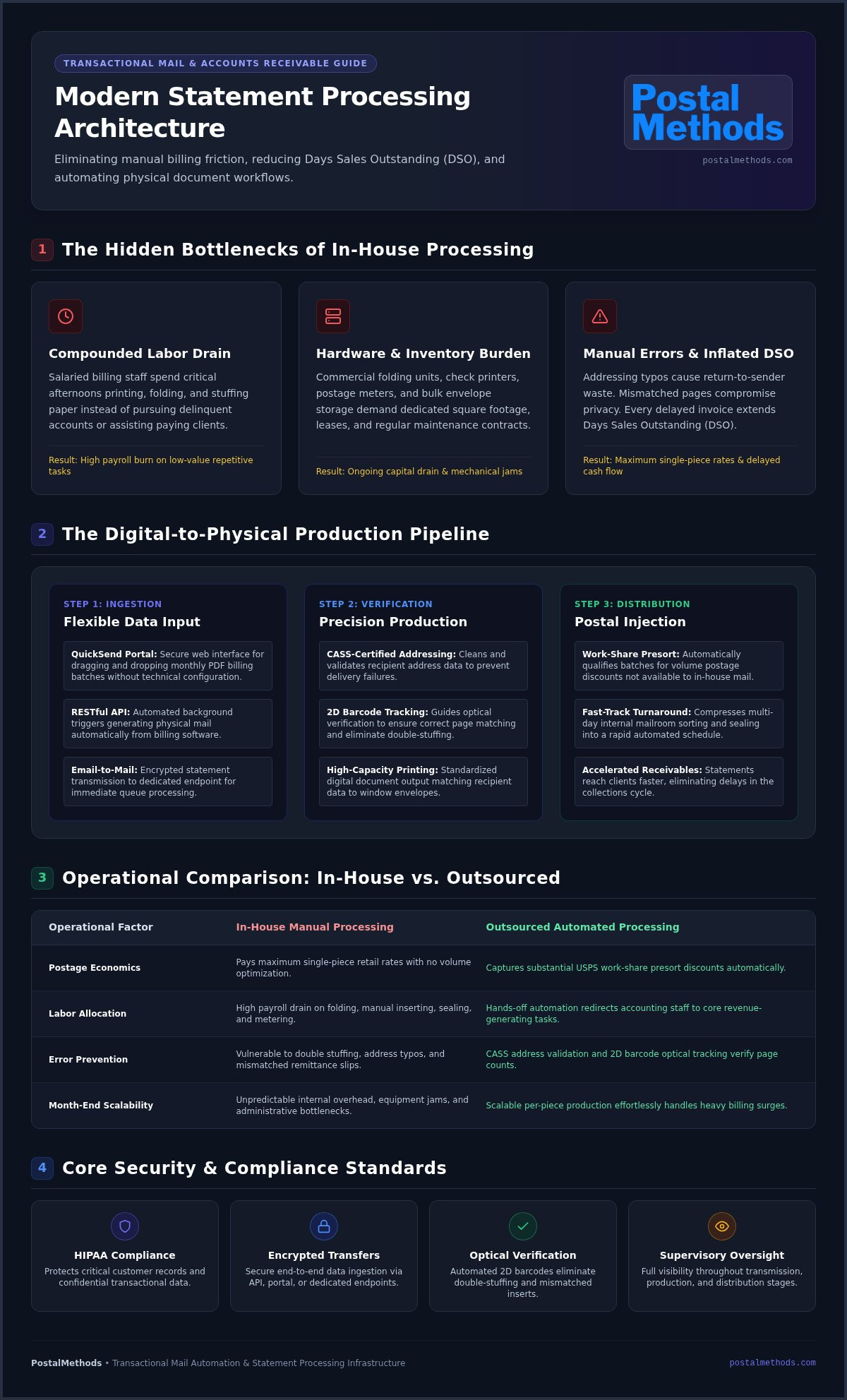
The bridge between raw billing data and a stamped envelope doesn’t require physical paper in your office. Modern outsourced statement processing functions as a streamlined digital-to-physical pipeline. Your system generates the billing data, secure protocols transmit the files, and industrial production lines print, fold, and deliver the physical pieces directly to the mailstream. This automated input-to-output workflow eliminates manual touchpoints, captures substantial USPS work-share presort discounts, and condenses a multi-day administrative chore into a matter of hours.
Regulated institutions shifting to this model retain full oversight of their customer communications. Meeting strict supervisory obligations for outsourced services requires visibility into every step of the transmission, production, and distribution sequence.
Data Ingestion: Portal vs. API vs. Email
Bridging the gap between internal accounting records and off-site production relies on flexible ingestion channels built to fit your existing tech stack:
- QuickSend Portal: A secure web application designed for on-demand batch jobs. Drag, drop, and send monthly PDF billing runs without technical configuration.
- RESTful API Integration: The ultimate hands-off engine. Your billing software programmatically triggers physical mailings the moment an invoice or late notice generates. Integrating your system with invoice printing and mailing services turns accounts receivable into an autonomous background process.
- Email-to-Mail Service: A lightweight method for ad-hoc transactional documents. Attach a statement to an encrypted email, send it to a dedicated endpoint, and watch it enter the print queue instantly.
The Physical Production Cycle
Once data arrives, automated production takes over. High-capacity digital printing engines standardize document layouts, apply CASS-certified addressing, and print high-density 2D barcodes. These barcodes guide industrial folder-inserter hardware through optical tracking checks. The machines verify page counts, eliminate double-stuffing errors, and match recipient records to the correct window envelopes.
Optical scanners inspect each finished envelope before it enters postal sorting trays. Instead of lingering in an office outbox, files received in the morning convert into verified, sealed, USPS-ready mailpieces within hours, pre-sorted to bypass regional sorting hubs and accelerate final delivery.
In-House vs. Outsourced: A Cost-Benefit Breakdown
Managing an internal billing operation creates unpredictable overhead that fluctuates wildly from month to month. Between keeping boxes of envelopes in stock, managing toner inventory, and leasing complex mechanical folders, businesses accumulate substantial soft costs. Turning to outsourced statement processing replaces volatile fixed expenses with transparent, predictable transactional fees. You pay only for what you send, eliminating capital tied up in unused materials and underutilized hardware.
For a detailed breakdown of transition strategies and receivable workflows, explore our Automated Invoice Mailing: The 2026 Guide.
Financial Impact on Accounts Receivable
Every business battles the payment float, which is the costly lag between generating a billing file and receiving collected funds. When accounting departments struggle with manual preparation, statements sit in office bins for days before entering the postal stream. Accelerated print-and-mail cycles close this window, getting remittance notices into customer hands significantly faster. Alongside prompt invoice delivery, businesses looking to minimize remittance friction can compare suitable payment gateways and processing solutions via payselect.ae to accelerate incoming collections.
Clean, standardized mailings also influence payment behavior. Recipient confusion drops when statements arrive with crisp layouts, accurate tear-off stubs, and pre-addressed return envelopes. While per-piece rates apply standard retail charges to individual letters, bulk commercial mailing fees aggregate massive volume to secure discounted work-share rates, generating immediate operational savings on recurring runs.
Scalability and Flexibility
Monthly billing cycles are rarely smooth. Most enterprises generate a steady trickle of notices mid-month, followed by massive volume surges during closing week and seasonal rushes. Handling these sudden spikes internally requires frantic overtime or temporary staffing agencies. Professional print partners absorb high-volume surges effortlessly, keeping delivery schedules consistent without disrupting your daily routine.
Growing organizations benefit most from agility. Partnering with a provider that requires no long-term contracts lets you scale production up or down based strictly on current operational volume. As postal rates adjust, your business avoids the administrative burden of recalibrating postage meters or auditing rate tiers. Your production partner handles logistics behind the scenes, allowing outsourced statement processing to function as a quiet, cost-effective extension of your accounting department.
Key Features of a Secure Statement Processing Partner
Protecting sensitive billing data requires far more than basic encryption. When evaluating outsourced statement processing partners, you must examine both digital pathways and physical floor procedures. A single exposed balance sheet or misdirected patient bill invites steep financial penalties and destroys customer trust. True security means every step, from transit to final envelope seal, is monitored and documented.
Healthcare providers face specific mandates when sending protected health information (PHI). For a complete breakdown of medical mailing requirements, review our HIPAA Compliant Mailing Services Guide.
Maintaining Regulatory Compliance
Medical billing demands formal accountability. Any production partner handling patient statements must execute a Business Associate Agreement (BAA) before processing live data. This document legally binds the vendor to HIPAA security standards, ensuring administrative, physical, and technical safeguards remain active across all systems.
Beyond healthcare regulations, legal notices and debt collections require verifiable delivery chains. Reliable facilities employ rigorous verification standards:
- Automated audit trails: Every file upload generates a time-stamped log marking ingestion, print queue assignment, and postal delivery release.
- CASS-certified address validation: Systems automatically cross-reference addresses against USPS databases to eliminate invalid recipients prior to production.
- Closed physical security: Print production environments utilize badge-only facility access, background-checked staff, 24/7 video monitoring, and secure shredding protocols for production spoilage.
Technology and Integration Capabilities
Secure transport protocols form the first line of defense. Reputable processors enforce TLS encryption in transit and AES-256 standards at rest. Direct integration through RESTful APIs allows businesses to trigger transactional mailings automatically without storing unencrypted files on desktop machines. Clean, comprehensive API documentation reduces developer onboarding to hours rather than weeks.
Connecting your enterprise CRM or accounting platform directly to production endpoints brings total operational visibility. Dashboard analytics provide real-time status updates as letters move from data files into the mailstream. If you are ready to remove manual compliance risks and streamline distribution, partner with a proven vendor offering HIPAA compliant printing and mailing services to safeguard your transactional output.
Streamlining Your Workflow with Postal Methods
Adopting modern outsourced statement processing shouldn’t require complex software overhauls or rigid commitments. Large legacy mail houses often demand multi-year agreements and slow onboarding schedules. Postal Methods takes a leaner approach. Operating as your silent partner, the platform absorbs the heavy lifting of print and mail distribution so your team can focus on core operational goals. You gain enterprise-grade mailing capabilities without purchasing hardware, leasing warehouse space, or signing long-term contracts.
Getting started takes minutes. Using the QuickSend Portal System, you export your statement batch, drag and drop the PDF file, and confirm the job. The system takes over immediately: print, fold, insert, meter, and deliver. Whether managing a routine monthly cycle or a sudden high-volume mailing, files move from your screen to the postal stream with complete transparency.
Automating Your Accounts Receivable
Healthcare providers, utility companies, and commercial service firms require distinct billing workflows. Medical clinics can transmit patient balance statements via HIPAA-compliant protocols without exposing protected health information. If you need a complete roadmap for transitioning your department, review our guide on How to Outsource Billing and Mailing.
When legal notices, demand letters, or critical account updates require immediate physical dispatch, the Email-to-Mail Service simplifies execution. Attach your document to an authorized email, click send, and route urgent transactional records straight to production without opening a browser or touching a printer.
The Future of Physical Business Mail
Digital inboxes are saturated with marketing spam and automated filters. Physical invoices cut through the digital noise. Transactional mail demands direct attention, establishing credibility and prompting faster customer action when paired with electronic reminders. Blending tangible statements into an integrated receivable strategy accelerates collections and keeps cash moving.
Eliminate manual mailroom friction for good. Dependable outsourced statement processing gives your organization complete distribution speed, proven data security, and total billing control. Streamline your business with Postal Methods today and turn your transactional mailing into an effortless background operation.
Accelerate Your Cash Flow and Modernize Mailing
Relying on manual office mailrooms burns valuable staff hours, creates costly compliance hazards, and needlessly drags out collections. Transitioning to outsourced statement processing turns repetitive billing runs into an agile, cost-effective advantage. You eliminate folding machine breakdowns, avoid addressing slip-ups, and ensure every statement reaches the mailstream with consistent speed.
Reclaiming operational focus doesn’t require software overhauls or rigid commitments. Postal Methods acts as your silent partner, providing proven HIPAA-compliant workflows, versatile RESTful API and portal access, and the peace of mind of no long-term contracts required. We handle the heavy lifting: print, fold, insert, and deliver. Free your team to focus on high-value priorities while your billing distributions run smoothly in the background. Start Automating Your Statement Processing with Postal Methods and build a faster, friction-free mailing system today.
Frequently Asked Questions
What exactly is outsourced statement processing?
Outsourced statement processing is the delegation of billing generation, printing, folding, inserting, and postal distribution to an external provider. Instead of managing physical mailrooms internally, your organization transmits digital billing data through secure web portals, APIs, or email endpoints. The provider handles high-speed printing, automated verification, and USPS entry, turning raw digital records into physical mailpieces without internal administrative effort.
Is outsourcing statement mailing more expensive than doing it in-house?
No, outsourced statement processing is typically more economical than in-house production once all operational expenses are factored in. Internal mailing requires salaried staff hours, hardware leasing, scheduled equipment maintenance, envelope stock, and full retail postage rates. Outsourcing replaces these volatile overhead burdens with predictable transactional rates while tapping into commercial volume presorting discounts that individual businesses cannot achieve on their own.
How do I ensure my outsourced statements are HIPAA compliant?
Verify that your mailing partner signs a formal Business Associate Agreement (BAA) before transferring sensitive patient files. The partner must enforce end-to-end data encryption during transit and rest, operate badge-restricted production facilities, and conduct routine employee privacy training. Look for automated optical tracking systems that confirm page counts and ensure patient records never intermix during folder-inserter assembly.
Can I track my statements after they are sent to the mail processor?
Yes, reliable providers offer complete visibility through centralized dashboards. Once files are transmitted via portal or API, real-time logging records every phase: file receipt, print queuing, mechanical insertion, and transfer to the USPS. Many platforms incorporate Intelligent Mail barcode (IMb) tracking, allowing you to monitor individual pieces as they pass through postal distribution facilities toward final delivery.
How long does it take for a digital file to be mailed out?
Digital files typically enter production and convert into physical mail within one business day. Because automated industrial systems eliminate manual folding and stuffing delays, verified batches move straight from electronic ingestion to USPS sorting trays. This rapid turnaround significantly shrinks your payment float, ensuring invoices reach recipient mailboxes much faster than standard office routines permit.
Do I need to sign a long-term contract for statement processing?
No, modern providers don’t require multi-year commitments or rigid service-level retainers. Platforms like Postal Methods operate on an agile, on-demand structure with no long-term contracts. You pay strictly for the transactional volume you process each month, giving you the operational freedom to scale production up or down based on current billing demands.
What types of documents can be handled through outsourced processing?
Providers manage a wide range of critical transactional documents. Common applications include recurring invoices, patient balance notices, legal correspondence, collection letters, and formal compliance notifications. Whether your team needs to distribute high-volume monthly billing statements or send urgent, one-off account updates via email triggers, industrial print systems format, fold, and mail each document with complete accuracy.
Can I integrate my existing CRM with a statement mailing service?
Yes, integrating your existing CRM or ERP software is straightforward using modern RESTful APIs. Your billing software can trigger automated print jobs based on system events, such as account closures, generated invoices, or past-due notices. For companies that balance physical mailings with electronic trade documentation across their enterprise systems, incorporating a cloud provider like 123 EDI ensures both digital and print billing workflows remain synchronized. For organizations seeking simpler deployment without custom coding, secure web portals and email-to-mail options provide direct document routing straight from your desktop.