

Hipaa Compliant Patient Billing and Mailing: Privacy Rules
Privacy depends on the information in a billing message and the safeguards around it, not simply on whether it is sent by mail or email. HIPAA compliant patient billing and mailing can include paper statements, which should be placed in sealed envelopes when they contain information about a person’s medical condition. Providers may also communicate with patients by email when they apply reasonable safeguards and limit the message to the information needed.
It’s understandable to want a clear rule before sending patient communications. HIPAA doesn’t categorically prohibit unencrypted email, but the patient’s preferences, the message’s contents, and safeguards against misdirected disclosure all matter. A patient may also request a reasonable alternative way or place to receive communications.
This article explains which billing messages can be mailed or emailed, how privacy and consent considerations affect those choices, and what to consider in vendor agreements and security credentials. It offers a practical guide to where the rules apply, so routine billing can proceed without overlooking patient privacy.
Key Takeaways
- Patient billing statements can be mailed in sealed envelopes; the information included and the safeguards used matter.
- Email communication calls for reasonable privacy protections, careful recipient checks, and only the information needed for the message.
- Before sharing protected health information with a mailing vendor, understand when a Business Associate Agreement applies and what it covers.
- Compare vendor security practices and credentials, including independent audit reports, as part of your privacy review.
- Patient authorization depends on the purpose and content of the communication, so distinguish routine billing from uses that call for separate permission.
Business Associate Agreements and vendor security certifications
Electronic billing statements and paper mail can both support HIPAA-compliant communication. Each requires safeguards suited to its route: electronic messages need protected transmission, while mailed statements need accurate addressing and sealed envelopes.
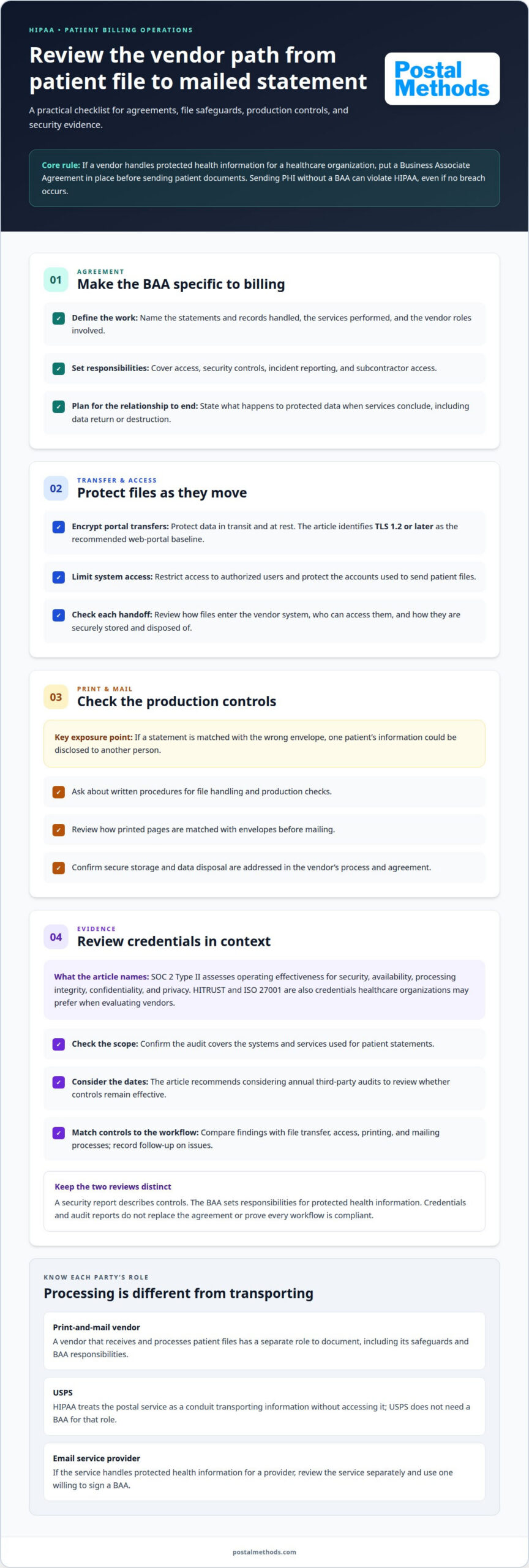
A vendor that handles protected health information for a covered healthcare organization is generally a business associate. Before sending patient documents to a transactional print-and-mail vendor, put a Business Associate Agreement (BAA) in place. Sending protected health information to a vendor without a BAA can violate HIPAA, even if no breach occurs.
Make the agreement specific to billing. Describe which statements and records the vendor handles, what services it performs, and who may access the information. Address security controls, incident reporting, subcontractor access, and what happens to protected data when the relationship ends. Clear terms make responsibilities easier to follow as statement files move from upload to printing and mailing.
Electronic claims and patient statements require attention at each transfer point. HIPAA Part 162 covers standard billing transactions, including claims and remittances. For portal transfers, use encryption while data is in transit and at rest; the recommended web-portal baseline is TLS 1.2 or later. Also restrict system access to authorized users, and protect accounts used to send patient files.
A print-and-mail workflow has distinct control points. Review how files enter the vendor’s system, how staff access them, and how printed pages are matched with envelopes. A mismatched statement and envelope, for example, could expose one patient’s information to another person. Ask whether the vendor’s written procedures cover file handling, production checks, secure storage, and data disposal.
Certifications and audit reports help assess controls, but they don’t replace a BAA or prove that every workflow is compliant. SOC 2 Type II assesses the operating effectiveness of controls related to security, availability, processing integrity, confidentiality, and privacy. HITRUST and ISO 27001 are also credentials healthcare organizations may prefer when evaluating vendors.
- Review the scope: Confirm the audit covers the services and systems used for patient statements.
- Check the dates: Consider annual third-party audits to review whether controls remain effective.
- Match controls to the workflow: Compare the report’s findings with file transfer, access, printing, and mailing processes.
- Track follow-up: Record how identified issues are addressed and how changes affect billing operations.
Use the BAA and security review together. A SOC 2 report may describe an organization’s controls, while the agreement sets the vendor’s responsibilities for protected health information. Reviewing both helps healthcare teams assess the complete path from claim submission to payment statement delivery.
What Is HIPAA-Compliant Mailing?
Yes. Healthcare providers may outsource billing and mailing under HIPAA when protected health information is handled with appropriate safeguards. HIPAA compliant patient billing and mailing includes a Business Associate Agreement when a third party handles that information on the provider’s behalf.
A BAA should describe the billing and mailing work, the records involved, and how the vendor may handle protected information. Set out practical responsibilities for access, safeguards, incident reporting, subcontractors, and data return or destruction when services end. For example, define how the vendor receives statement files, who can use them, and how remaining files are managed after a mailing.
The agreement should match the actual workflow. A mailing vendor that receives patient names, addresses, and balances may handle protected health information while preparing physical statements. For HIPAA compliant patient billing and mailing, address these activities directly in the BAA rather than referring broadly to “mailing.” Organizations can also document which staff roles need access and how the vendor reports problems involving patient records.
Email providers need a separate review. If a service stores, transmits, or otherwise handles protected health information for a healthcare provider, the provider should use an email service willing to sign a BAA. A patient statement attached to an email, for instance, can expose more information than a message directing the recipient to a secure document portal.
USPS has a different role. HIPAA treats the postal service as a conduit that transports information without accessing it, so USPS doesn’t need a BAA for that role. A print-and-mail vendor that receives and processes patient files is not simply transporting sealed mail. Its handling of those files makes the vendor relationship a separate consideration.
Identify each party and its role before sending records. This helps show where a BAA applies and where the information goes next.
- Healthcare provider: Determines the purpose and content of billing communications.
- Email service provider: May handle electronic protected health information and should be willing to sign a BAA.
- Print-and-mail vendor: May process patient files to produce and send statements, so document its role and safeguards.
- USPS: Transports the finished mail as a conduit without accessing its underlying information.
Before a statement run, map each transfer: provider to email platform, provider to mailing vendor, and vendor to USPS. Record which party can access the data at each stage. This workflow view can reveal whether an agreement is needed and whether its scope matches the service being performed.
For a physical statement workflow, consider a secure healthcare mailing process that moves patient documents from file handling through printing and postage.
Types of patient communications allowed by mail
Healthcare organizations may send billing statements and inserts to patients through USPS mail. A statement can include account details needed to explain a balance, but its contents should stay relevant to the billing purpose. If a mailing includes information about a person’s medical condition, use a sealed envelope. Keep the exterior free of details that reveal the patient’s care.
Other routine communications can also be sent by mail. Providers may send appointment and prescription refill reminders by postcard when the message contains no protected health information. If a patient has requested confidential communications, use a closed envelope instead. Choose the format based on both the information in the message and the patient’s communication preferences.
For recurring statements, patient segmentation and mail-merge workflows help match each document to its intended recipient. Separate the billing file by communication type, then compare each record’s patient identifier and address before production. For example, a payment reminder should draw the correct balance and mailing address from the same account record. Limit file access to staff who need it, and review a sample before releasing the full job.
Address quality matters. CASS-Certified address validation can verify addresses before statements are printed. NCOA processing can identify patients who moved using approximately 48 months of USPS data. If mail is returned, capture the reason, update the address record through the organization’s process, and keep a report for follow-up. Don’t automatically resend a returned statement to an unverified address.
For privacy-safe direct-mail attribution, track delivery and response without exposing patient details in campaign labels or return data. Use an internal account reference to match a response to a billing record, and restrict access to that match. Avoid putting diagnoses or treatment details in external tracking fields. This keeps reporting useful while limiting unnecessary disclosure of protected health information.
A statement sent to the wrong recipient isn’t automatically a reportable breach. Assess the event under HIPAA’s Breach Notification Rule, including the exclusion criteria in §164.402, and document the decision. If it qualifies as a breach, affected patients must be notified within 60 days, according to the U.S. Department of Health and Human Services Office for Civil Rights. For incidents affecting fewer than 500 individuals, notify affected individuals within the required timeframe and submit the breach report to HHS as part of the annual reporting process.
- Before mailing: Match each statement, insert, and address to the intended account.
- After a return: Record the reason and correct the address before sending again.
- After a mis-mail: Preserve the facts, assess whether the event qualifies as a breach, and follow applicable notification duties.
HIPAA compliance and patient privacy
Privacy depends on how healthcare teams use patient information across billing operations. The HIPAA Privacy Rule requires workforce training on applicable policies and procedures under §164.530. Train billing staff to recognize protected health information, follow approved workflows, and report suspected disclosures to the designated compliance contact. A payment reminder, for example, should reveal only details needed to explain the balance.
Apply the minimum necessary standard when using or sharing information for billing. HIPAA identifies this standard in §164.502(b) and §164.512(d). In practice, limit each file and message to information required for its purpose. A statement may need a patient identifier and balance, while a campaign report may work with de-identified totals instead of names and diagnoses.
Electronic safeguards should cover the full route, from account access to delivery. Use unique user accounts, strong authentication, and encryption for electronic protected health information. Restrict billing records to authorized personnel and remove access when staff responsibilities change. For email, verify the recipient address and use a secure method for sensitive attachments. If a patient requests confidential communications, document the request and use a reasonable alternative channel.
Physical controls matter, too. Limit access to printed statements, secure files awaiting production, and reconcile completed jobs against their source records. A misplaced page or an envelope containing another patient’s statement can expose private information. Keep incident records, investigate what information was involved, and assess who may have received it. Clear operating procedures help teams respond consistently instead of relying on memory.
If an impermissible disclosure qualifies as a breach, healthcare organizations must notify affected patients within 60 days, according to the U.S. Department of Health and Human Services Office for Civil Rights. The same office states that civil penalties may be less than $100 or more than $50,000 for each violation. The incident’s circumstances and applicable enforcement rules matter, so document the assessment and actions taken.
- Train: Use billing examples to show staff which information each task needs.
- Limit: Grant system and document access only to authorized roles.
- Protect: Secure electronic transfers and physical records throughout processing.
- Document: Record privacy requests, incident assessments, and corrective steps.
These controls work best as one process. A privacy request should flow into billing records, communication preferences, and mail preparation. A suspected exposure should prompt a documented review, timely decisions, and any required patient notification. Consistent records help organizations understand what happened and improve safeguards across future billing operations.
When is patient authorization required to mail billing statements?
For a routine statement sent to a patient about payment, a separate HIPAA authorization is generally not the deciding requirement. The key questions are whether the communication supports billing, who will receive it, and whether the patient has requested confidential communications.
Medical billing transactions fall under HIPAA Part 162, including claims and remittances. A statement sent to the patient to explain an amount due serves a different purpose from sharing the patient’s information for marketing or another unrelated use. Keep the message focused on the account and the payment, rather than adding details that don’t help the patient understand the bill.
Check the patient’s communication preferences before sending. Under 45 C.F.R. § 164.522(b), an individual may ask a covered provider to communicate by alternative means or at an alternative location when the request is reasonable. For example, if a patient asks to receive billing mail at a different address for confidentiality, record the request and apply it to the statement workflow.
Email consent and HIPAA authorization are separate considerations. HIPAA permits providers to communicate with patients by email when they apply reasonable safeguards. If a patient initiates an email exchange, the provider may assume email is acceptable unless the patient has said otherwise. Verify the recipient address, limit the message to necessary billing information, and offer another method if the patient finds unencrypted email unacceptable.
A separate authorization may be relevant when a proposed use or disclosure falls outside the permitted purpose of routine payment communications. Before including a third party, such as a family member, confirm the applicable permission or other basis for disclosure. Don’t assume a person’s relationship to the patient automatically permits them to receive account details.
Keep authorization records organized. HIPAA authorization forms must be stored for a minimum of 6 years. Retain the form with the relevant billing records, note its scope, and make sure staff can distinguish permission for a particular disclosure from a patient’s preferred mailing address or communication channel.
- Routine patient statement: Keep it tied to billing and send it through the patient’s recorded communication channel.
- Confidential communication request: Record the requested method or location and use it when reasonable.
- Disclosure to another person: Establish the appropriate permission or other basis before sharing account information.
For organizations moving statement files into physical mail, HIPAA-compliant printing and mailing can support the production and delivery workflow.
Postal Methods: HIPAA Compliant Printing & Mailing Services
Postal Methods helps healthcare organizations move patient billing documents from digital files to printed, folded, stamped, and mailed statements through its HIPAA Compliant Printing & Mailing Services. Use the service when in-house production creates extra handling steps or statement runs need a coordinated process from file submission through postage.
Invoice Printing and Mailing Services can support other billing correspondence, while Notice Printing and Mailing Services are designed for patient notices. These services keep routine physical mailings within a print-and-mail workflow, allowing healthcare teams to focus on preparing accurate records and managing patient communications.
For patient statements or related billing mail, visit Postal Methods to discuss your mailing workflow.
Put your billing workflow into motion
Make your next step operational: map how each patient billing file moves from preparation to delivery, and assign responsibility at every handoff. A clear process connects privacy decisions to day-to-day work instead of treating them as a separate task. That’s the practical foundation for HIPAA compliant patient billing and mailing.
When physical statement production is the bottleneck, Postal Methods provides HIPAA Compliant Printing & Mailing Services. Its Invoice Printing and Mailing Services and Legal Printing and Mailing Services can support other document workflows, too. Choose the service that fits the communication you need to send, then map the workflow from file submission through mailing.
Contact Postal Methods to discuss your mailing workflow and take the next step with confidence.
Frequently Asked Questions
What Is HIPAA in Medical Billing?
HIPAA in medical billing governs how covered healthcare organizations use and protect identifiable patient information during billing activities. It applies to more than the final statement: eligibility checks, claims, and remittances are also standard transactions under HIPAA Part 162. For example, staff preparing a claim should handle only the records needed to process that claim, while keeping billing access limited to appropriate roles.
What Is Healthcare Direct Mail?
Healthcare direct mail is physical communication sent to patients or other recipients for a healthcare-related purpose. It can include billing statements, appointment reminders, prescription refill reminders, and notices. The message and envelope design matter: a postcard reminder should avoid patient-specific medical details, while a statement containing sensitive information belongs in a sealed envelope. Keep the mailing’s purpose clear and leave unnecessary details off the exterior.
What are the potential risks of sending billing information via email?
Email can expose billing information if staff use the wrong recipient address, attach the wrong document, or send sensitive details through an unprotected account. A message that is forwarded or accessed by someone else can also disclose information beyond its intended audience. For example, an attachment with a full statement may reveal more than a short payment reminder. Verify addresses, limit message content, and choose safeguards suited to the information being sent.
What HIPAA rules apply to patient billing and mailing?
The HIPAA Privacy Rule governs use and disclosure of protected health information, while the Security Rule applies to electronic protected health information. Part 162 covers standard billing transactions, including claims and remittances. A practical distinction: paper statements need privacy protections during preparation and delivery; electronic claim files need safeguards during access and transmission. Vendors handling information for a covered organization may also require a Business Associate Agreement.
What patient information may be included in mailed bills under HIPAA?
A mailed bill may include information reasonably needed to identify the account, explain charges, and tell the patient how to pay. This can include a patient name, account reference, service details, balance, and payment instructions. Keep the content relevant to billing. For instance, don’t add a diagnosis to a payment notice if the patient can understand the amount due without it.
What safeguards should healthcare providers use when mailing patient bills?
Use safeguards wherever a statement could be exposed or mismatched. Validate the recipient and address, restrict access to billing files, and match each printed statement to its envelope. Keep statements containing medical-condition information sealed, and avoid revealing sensitive details on the envelope. A sample review before release can catch a wrong name, balance, or address before the full mailing enters the delivery stream.
How should providers address returned or misdelivered patient billing mail?
Record a returned item’s reason, correct the address through the organization’s process, and avoid sending it again until the recipient information is verified. For misdelivered mail, secure any available details, determine what information was exposed and to whom, then assess whether the incident meets HIPAA’s breach criteria. If notification is required, affected patients must be notified within 60 days, according to the U.S. Department of Health and Human Services guidelines.