


Cost of Sending an Invoice by Mail in 2026: Postage Rates
Envelope size can affect the cost of sending an invoice by mail in 2026, even when the document is light.
It’s easy to assume the destination is the main factor, but for regular First-Class letters within the United States, it usually doesn’t change the price. What matters most is how the envelope is classified by its size, thickness, shape, and weight. This guide explains how those details affect postage, what extra ounces can add, and when mailing abroad changes the calculation. You’ll also see how to think about postage alongside the practical work of preparing and sending invoices, so the cost is easier to estimate before each mailing.
Key Takeaways
- Check an envelope’s dimensions, thickness, and weight together; any of them can affect how USPS classifies the mail and prices postage.
- Extra pages or inserts can push an invoice into a higher weight tier, so weigh the complete, sealed envelope rather than the paper alone.
- For domestic First-Class letters, the destination usually doesn’t change postage; sending an invoice internationally follows a different rate.
- A standard #10 envelope is a familiar option for invoices, but its contents and final thickness still matter when calculating postage.
- To reduce manual handling, businesses can use Invoice Printing and Mailing Services to move invoices from digital files to prepared, mailed documents.
Postage for large envelopes and additional ounces
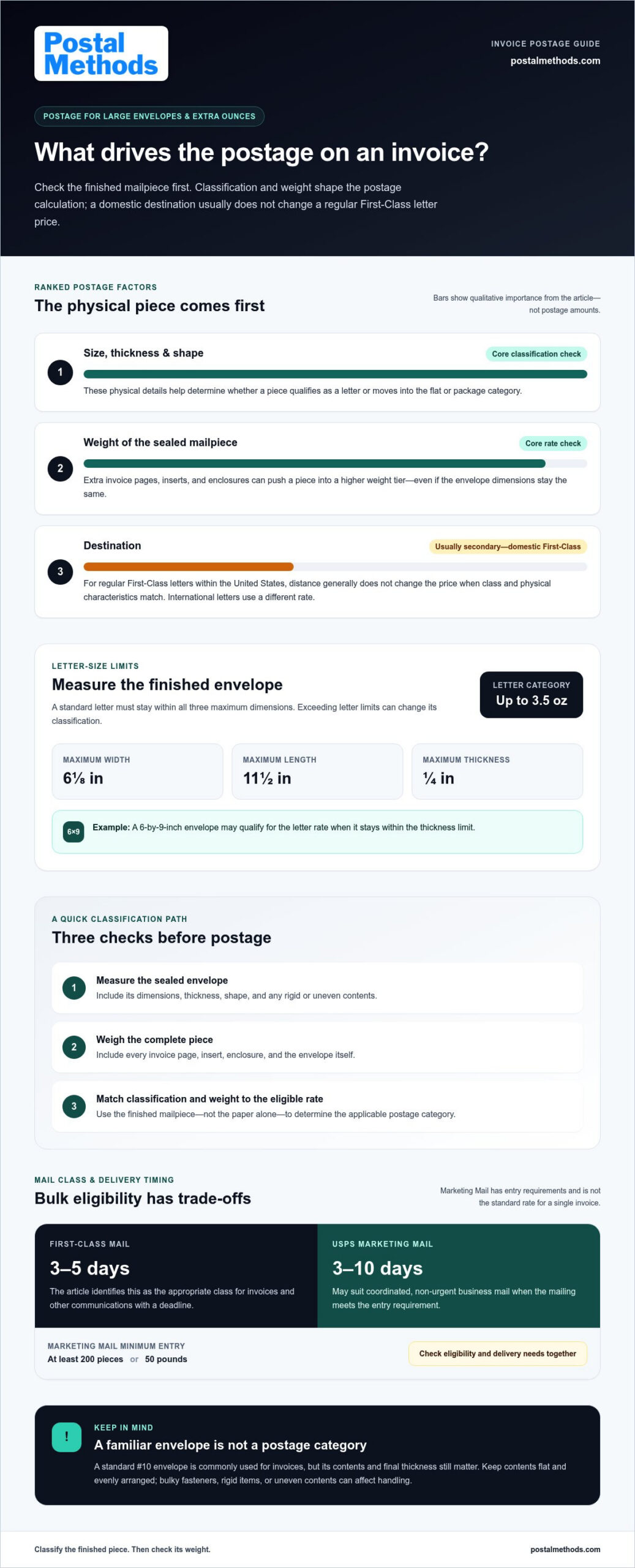
A document’s weight is only part of its postage classification. USPS also considers the envelope’s dimensions, thickness, and shape. A standard letter can be no wider than 6-1/8 inches, no longer than 11-1/2 inches, and no thicker than 1/4 inch. A 6-by-9-inch envelope may qualify for the letter rate when it stays within the thickness limit. Once a mailpiece exceeds letter limits, its postage can move to the flat or package category.
That distinction matters for invoices with several pages, inserts, or rigid contents. A standard letter weighing up to 3.5 ounces remains within the letter category, but a large envelope is priced as a flat. Those examples show why the final mailpiece’s classification and weight matter together.
- Measure the sealed envelope, including its thickness.
- Weigh the complete piece with every invoice page and insert inside.
- Apply the rate for its classification and weight, not just the paper inside.
The way you buy postage can also affect the rate for a regular letter. An invoice packet may move into a higher weight tier when you add pages, even if the envelope dimensions stay the same.
Large-scale mailings may qualify for different pricing, but USPS Marketing Mail has entry requirements. A mailing needs at least 200 pieces or 50 pounds. These are bulk-mail rates, not the standard postage rate for a single invoice.
Marketing Mail can suit a coordinated batch of notices or other non-urgent business mail. Delivery takes 3-10 business days, so timing matters when choosing a class for invoices. First-Class Mail is the appropriate class for invoices and other communications with a deadline, with delivery in 3-5 business days. Compare both the mailing’s eligibility and its delivery needs before selecting a bulk rate.
Printing is another part of the total mailing cost. The examples here describe different formats, so they are not interchangeable postage rates. Page count, envelope format, mailing class, and destination all affect the final calculation.
To estimate the cost, settle on the format, then weigh and measure the finished piece and identify its eligible mail class. For a case-specific quote, provide the document length, envelope format, mailing quantity, and destination.
Whether destination affects First-Class letter prices
For a regular First-Class letter sent within the United States, the destination usually doesn’t change postage. A letter crossing a state and one traveling across the country generally have the same domestic price when their mail class and physical characteristics match. Class, weight, and format matter more than destination, so businesses can estimate routine invoice mail without treating each ZIP Code as a separate postage rate.
International mail is different. Its rate applies to an international letter, not a domestic piece sent to a distant address. When estimating invoice postage, separate recipients inside and outside the United States, then classify each finished mailpiece. Mixing domestic and international pieces in one estimate can lead to an incorrect calculation.
Purchase method can affect the amount paid, even when the domestic destination does not. USPS lists different postage for stamped and metered letters. Businesses can buy postage for individual pieces at a post office or use metered postage to prepare mail. The class, weight, and format still determine the applicable rate. Compare those details before factoring in any discount; a nearby address does not automatically mean cheaper postage.
Certified Mail adds a service to the mailing, so its total differs from ordinary First-Class postage. These are purchase-method examples for Certified Mail, not prices based on the recipient’s distance. Return Receipt options provide a USPS signature record, whether the receipt is electronic or a physical green card.
Presorted First-Class Mail can reduce postage for eligible batches. The discount depends on presorting and mailing volume, not on how close the recipient lives. Businesses sending only a few invoices shouldn’t treat bulk rates as the standard price for regular mail. Keep eligible presorted pieces separate from ordinary, individually prepared letters.
Format matters when comparing postage. An invoice in a letter is not priced as a postcard just because it is lightweight. Printing choices can affect the finished mailpiece’s weight and format, while the domestic destination usually does not change the regular First-Class letter price.
For a mixed mailing, sort addresses into domestic and international groups, then identify each mail class and purchase method. Keep Certified Mail separate from standard letters, and count presorted pieces before using a bulk rate. Businesses handling repeated invoice batches can use an organized invoice mailing workflow to coordinate printing, postage, and physical delivery.
Invoice mailing in a standard #10 envelope
A standard #10 envelope is commonly used to mail business invoices and statements. The postage depends on the sealed piece’s weight and shape, not the envelope name alone. Include every invoice page, insert, and enclosure when weighing it. A single-page bill may stay in one weight tier, while a multi-page statement can move into another. Check the completed mailpiece before applying postage, especially for a monthly billing cycle with different page counts.
These weight tiers apply to letters. An envelope that exceeds letter-size or thickness limits may be classified as a flat instead, changing the postage calculation.
Shape matters, too. A standard sealed #10 envelope containing paper pages avoids USPS non-machinable surcharge triggers. Bulky fasteners, rigid objects, or uneven contents can affect how a piece is handled. Keep invoice contents flat and evenly arranged, then inspect the sealed envelope before mailing.
Estimate postage from the finished envelope, not page count alone. Weigh a representative piece from the batch, including its envelope and every insert. If invoice weights vary, sort the pieces into weight groups before preparing postage. A one-page invoice and a longer account statement, for example, may belong in different groups. Using the same envelope format helps organize the mail, but it doesn’t make every piece the same weight.
First-Class Mail also provides a useful delivery safeguard for routine invoices: USPS forwards or returns undeliverable pieces at no extra charge. That can help maintain a mailing record when a customer has moved, though the returned piece still needs attention. Keep address updates and returned mail together with the relevant billing records. A clear process makes it easier to identify undelivered invoices and correct customer details for the next mailing.
Use Certified Mail when a mailing needs a USPS record of delivery. The Certified Mail fee is $5.55 under current 2026 rates effective July 12, in addition to postage. Choose the receipt format based on how the business needs to retain delivery documentation. These services add charges beyond ordinary invoice postage.
For a recurring monthly mailing, keep ordinary invoices separate from pieces requiring Certified Mail. Record the number of each format, the weight group, and any extra service used. This makes it easier to compare postage across billing cycles and spot when additional pages or inserts change a piece’s classification. The cost of sending an invoice by mail in 2026 starts with a correctly prepared envelope and a postage choice that matches its contents.
How can businesses reduce the cost of printing and mailing invoices?
Reduce invoice mailing expenses by controlling the finished piece and its preparation. Start with a representative invoice, including the envelope, pages, return slip, and every insert. Weigh and measure the complete sample, then review whether each extra page is necessary. Removing unneeded enclosures reduces paper use and may keep the piece within its current weight classification.
Standardize invoice layouts across billing cycles to avoid duplicate pages, oversized inserts, and unnecessary variation between customer accounts. Keep required payment details together and position the return portion efficiently. Before printing a batch, compare sample invoices from accounts with different histories. A long statement may need more pages than a simple invoice, so group formats according to their actual contents rather than printing every account identically.
Keep address data current and organized. Returned mail creates follow-up work and can delay payment, even when USPS forwards or returns an undeliverable First-Class piece at no extra postage cost. Record returned items on the customer account, correct the address in your billing system, and use the updated record for the next cycle. This helps prevent documents being printed and mailed again to an outdated address.
Group eligible mailings before preparation. USPS presorted First-Class Mail has a 500-piece minimum, so a smaller invoice batch won’t meet that entry threshold on its own. Businesses with recurring billing dates can review whether several scheduled batches can be prepared together without delaying invoices. Keep invoices requiring timely delivery distinct from non-urgent notices, and select the mail class according to the communication’s purpose and deadline.
Bulk mail also involves setup costs, not just postage. USPS charges a $390 annual mailing fee for each mail class, and a permit imprint has a $390 application fee. Include these fixed charges in the yearly mailing budget before comparing bulk postage with individually prepared mail. A larger mailing may spread fixed costs across more pieces, but eligibility, sorting work, and delivery timing also affect whether a bulk approach fits.
Track useful details each billing cycle, such as piece count, invoice format, page count, weight group, postage method, and returned mail. Compare similar batches, not unlike documents. If a cycle costs more, check whether extra pages, a changed insert, a different mail class, or additional handling caused the increase. This makes your monthly mailing record a practical guide for planning the next run.
For recurring invoice workflows, reduce handoffs by coordinating document preparation, printing, and mailing through one process. Streamline invoice printing and mailing when manual batch preparation is taking staff time away from billing and account work.
Postal Methods: HIPAA Compliant Printing & Mailing Services
Postal Methods’ Invoice Printing and Mailing Services moves invoice documents from digital files to physical mail, handling printing and mailing to reduce the manual work of preparing recurring billing batches. For sensitive medical documents, HIPAA-Compliant Printing and Mailing provides an option suited to that correspondence.
Consider this approach when invoice preparation takes staff time away from billing, customer accounts, or payment follow-up. Postal Methods can also support legal documents and notices through its Legal Printing and Mailing Services and Notice Printing and Mailing Services. Choose the service that matches the documents your team needs to send. To discuss your invoice mailing needs, visit Postal Methods.
Make invoice mailing part of a smoother billing workflow
Make postage planning a repeatable part of your billing process. Set standards for invoice files, envelope preparation, address updates, and returned mail. When a document changes, review the finished piece before the next mailing run. This keeps billing operations aligned as customer needs and invoice formats evolve.
Estimating the cost of sending an invoice by mail in 2026 is one part of the decision. The other is deciding how much staff time your team should spend preparing physical documents. Postal Methods offers Invoice Printing and Mailing Services for recurring invoice workflows, HIPAA Compliant Printing & Mailing Services for sensitive medical documents, and Legal Printing and Mailing Services for legal correspondence.
Choose a process that fits your documents and keeps routine work moving. Contact Postal Methods for mailing help and discuss a practical next step for your business.
Frequently Asked Questions
Does envelope size affect how much it costs to mail a letter?
Yes. Envelope dimensions, thickness, shape, and weight determine whether USPS classifies a piece as a letter, flat, or package. A document in an envelope that exceeds letter limits, for example, may be charged as a flat even if it weighs little. Measure the sealed mailpiece and check its contents before choosing postage. A larger envelope isn’t automatically a package, but its final dimensions and shape matter.
Does the cost change by destination?
For regular First-Class letters sent within the United States, destination usually doesn’t change postage. An invoice mailed nearby and one sent across the country generally use the same domestic rate if their mail class and physical characteristics match. International mail is priced differently.
What is the 2026 USPS First-Class Mail postage cost for sending a standard invoice letter?
For a one-page invoice, the relevant rate depends on the completed envelope’s weight and how postage is purchased. Add all inserts before weighing, since the invoice alone doesn’t determine the final weight tier.
What are the 2026 USPS postage rates for large envelopes and heavier invoice mail?
A mailpiece may qualify as a flat if its dimensions or thickness exceed letter limits. Heavier invoice mail can also move into a different classification. Weigh and measure the sealed piece, then use the rate for its category.
How much do invoice printing, paper, and envelope supplies cost per mailed invoice?
There’s no single supply cost for every invoice. The total depends on page count, paper, inserts, and envelope format. Printing and postage are separate cost components, and staff time for folding, inserting, and preparing mail can affect internal costs. To estimate your per-piece expense, track those inputs for a representative invoice instead of relying on postage alone.
How do postage meter and presorted mail rates compare with USPS retail rates for invoices?
Presorting is for eligible batches, not individual invoices. Compare the potential postage savings with the preparation requirements and mailing volume.
What is the total per-invoice mailing cost for businesses sending invoices in different volumes?
The total includes postage, printing, paper, envelope supplies, and any additional handling or services. Small and large batches can have different per-piece costs because eligible presorted rates require a minimum volume. Estimate the per-invoice cost by dividing the batch’s combined mailing and preparation expenses by the number of completed invoices. Keep special-format or tracked mail separate from routine letters for a clearer comparison.
What USPS size, weight, and thickness rules affect the cost of mailing an invoice?
A standard USPS letter can be no wider than 6-1/8 inches, no longer than 11-1/2 inches, and no thicker than 1/4 inch. Standard letters can weigh no more than 3.5 ounces; heavier pieces are classified as flats or packages. A 6-by-9-inch envelope may qualify for the letter rate if it stays within the thickness limit. Measure and weigh the sealed invoice, including every insert.